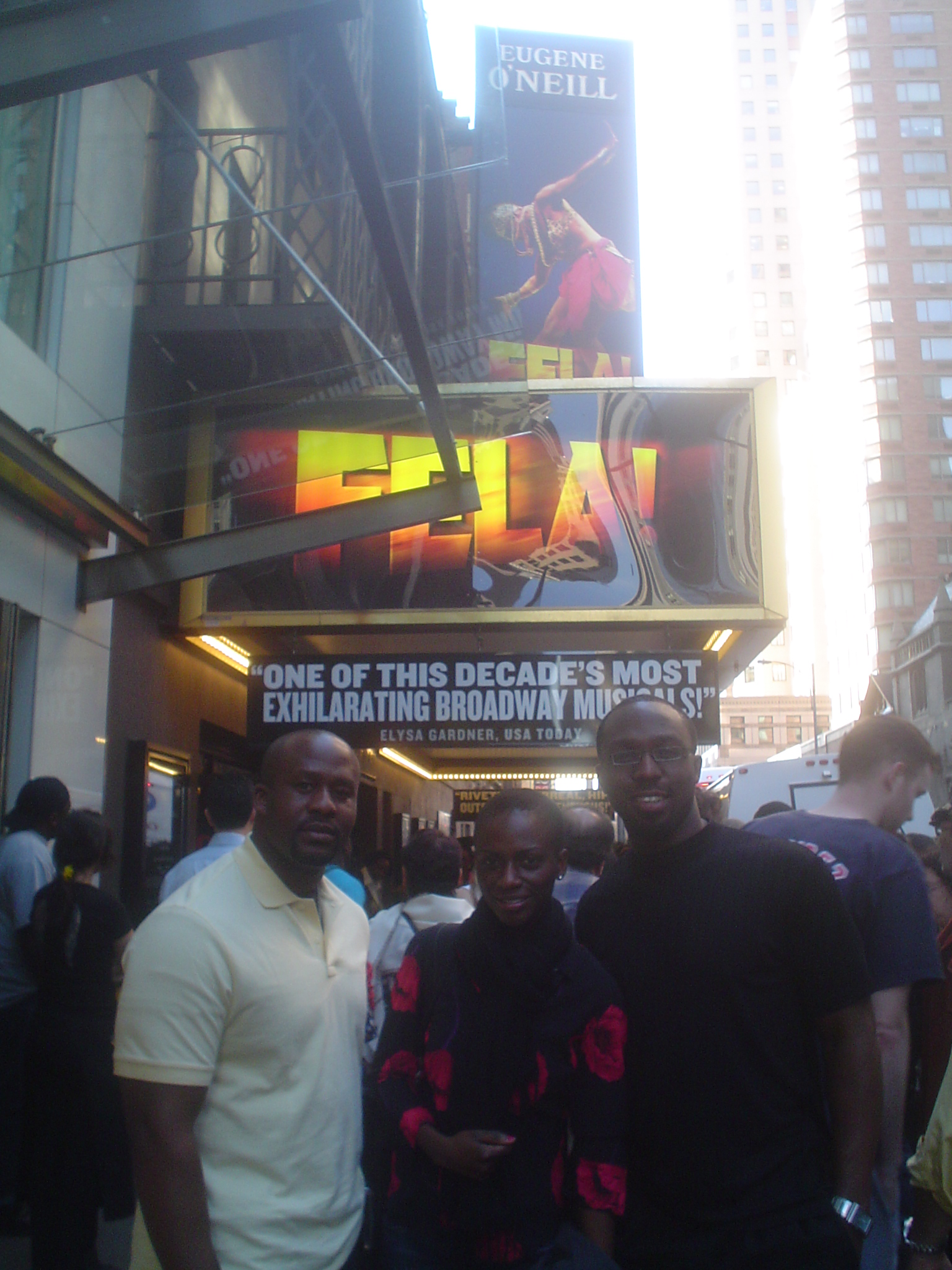
 As I made my way into the Eugene O’Neill Theatre in New York, New York – I was conscious to remind myself of some decision made days earlier: I was to be void of any expectations whatsoever entering this theatre. I didn’t want to be bogged down with the wonderment of how an enigmatic figure can possibly be brought to life in a manner worthy of applause. All the same, showing this sunny afternoon was “FELA!” – a musical chronicling the life and times of one of Africa’s greatest exports, Fela Anikulapo-Kuti.
But still, I couldn’t help myself. Right to my left, inside the entryway, was a board listing the cast of the show. And as though transfixed in a moment of trance, I found myself frantically searching the list for one—if any at all—Nigerian name (Fela was Nigerian after all, and hey, so is yours truly). My eyes soon locked on one, and for a second, I realized I was breaking my self-imposed rule of zero expectations. But all I could think was … Goodness, juuust one! I quickly composed myself, I had to; there were folks behind me waiting for me to be done already with my nationalistic analysis.
And there I was, in this moderately-sized theatre, ten minutes before the show was scheduled to begin. A band was performing on stage, warming up the crowd with some funky jazz threaded with West African beats. But also staring back at me was a band with members who were the farthest shade possible from brown or black. Once again, my brain went into overdrive. Ordinarily, this wouldn’t be a problem—you get talent wherever you can find it. But then, I also knew two things: first, Fela’s famous bands were wholesomely brown/black; second, Fela was the greatest proponent of pan-Africanism and championed the authenticity of African art. The band, I later found out, goes by the name Antibalas.
But heck, this is Broadway; reality is oft on a collision course with the marketable and the possible. I wisely made my peace and settled into a seat in the left mezzanine section of the theatre.
If you didn’t know who Fela was, you need not worry – cause out came Fela in one of his peculiar trademarks: a fitted one-piece outfit. He walked to the band, gave some fist bumps, made some gyrations here and there, and as though on cue, the whole theatre had taken on new energy with the arrival of this principal actor.
He spoke. OK, I guess this is where I should explicitly make a disclaimer: I’m writing through the lens of a native, so certain statements may randomly jump out, which may or may not have an overall bearing on the quality of this show. Alright, where were we? Oh, yes … he spoke. It didn’t matter to me what he was saying, all what was filtering through my head was: this accent could maybe pass for that of an East African, but it’s so distinctively not even close to an accent of a Nigerian. Once again, I was subconsciously confronting my brigades of zero expectations. I turned to my sister who was sitting to my left to assure me I was not seeing spider webs where none existed: she affirmed my suspicion. After this, the show and everything about it got my blessing to proceed.
The year was 1977. A thousand soldiers had just stormed Kalakuta Republic—the self-proclaimed independent nation created by Fela in Lagos, Nigeria—and Fela was giving his last performance at The Shrine. Fela welcomes us “na de Shrine.”
Adjacent to the stage, on the left-hand side, was a picture of Funmilayo Kuti on the wall. Fela’s beloved mother had been dragged up the stairs of a two-story building and flung out through the window, onto the ground below, by “unknown” soldiers who had stormed the compound. For a moment, Fela pays homage and laments the death of this precious woman who matters so much to him. He even contemplates leaving Nigeria altogether as a result. She is to become a central piece in the show.
The musical, FELA!, makes no apology for the man. It is brilliant and poignant in highlighting the man’s demons and angels.
We follow Fela with great detail as he makes the twists and turns in his iconic life. From his rebellion in London not to study medicine as his mother originally intended, but instead choosing music; we get a view into the man’s early life and thought pattern.
Fela pioneered Afrobeat music – which is an amalgamation of Yoruba music, jazz, highlife, funk rhythms, strong percussion, and distinct vocal styles. He was in short, the Commander-in-Chief of the African orchestra.
Fela was notorious in challenging the military regimes that blanketed Nigeria and suffocated the lives of everyday citizens. And at other times, lambasted citizens whose excesses were in communion with those of the dictators. His music was often rife with insults and metaphors hurled at these oppressors who turned the country into a personal playground. The show incorporated recent events into some of the original songs; for example, in a song calling the military dictators “thieves,” AIG conspicuously manages to find its way in there. Well, if you were looking for complete originality, I think you can still let this pass without much ado.
But how did a young man become so radicalized and awakened? The show does a perfect and laudable job of introducing us to the experience of young Fela while touring the U.S. with his band. His encounter with Sandra Smith—a member of the Black Panther Party—who exposed him to the Black Power movement that was enveloping the U.S. in the 60s was a spectacular sequence in good theatre.
FELA! the show and Fela the man interacted with and engaged the audience; effectively and simultaneously challenging the use of all five senses As a Nigerian, there was no denying the meshing of cultures taking place inside the theatre. A friend even remarked during the show: “It seems non-Africans are having much more of an awesome time than we are in here.”
Of course, the man was not always glorified. Fela’s illogical and outrageous decision to marry 27 wives on the same day was nicely parodied by Fela and the group of beautiful women who surrounded him on stage in this theatre. And oh yes, Fela detailed in lurid terms the ordeal of his jail stints in the hands of the military dictators. I will leave you to go experience the R-rated language for yourself.
But I strongly suggest you do not see the show on an empty stomach: the head shaking, the hip twisting, the arm curling, and all the uncountable gyrations and jiving is bound to make you light-headed at some point if hungry. And this, without doubt, will rob you of one of the most incredible aspects of a two-and-a-half hour show.
Fela, whose last name “Anikulapo-Kuti,” means one who has death in his pouch – and – refuses to die, definitely lives up to his name in the biggest city on earth. The legend lives on Broadway, and shuns death himself, even in death.

 The Restless ChronicleS
Leave a comment