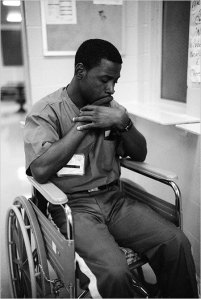
In 1989, 13 year-old Joe Sullivan broke into a house and brutally raped the 72 year-old woman living in it. It is a crime no mind on earth should dare conjure … and yet it happened; an equivalent of a grandchild raping the grandma.
Prior to this, the 13 year-old had accumulated a rap sheet that boasted 17 crimes, several of which were serious felonies.
The judge in this last case sentenced the youth to life without the possibility of parole, deeming him too hazardous for society after multiple failed attempts at rehabilitation.
Now, Joe Sullivan represents the worst humanity has to offer. But is a guaranteed life behind bars a legally-protected outcome for a crime committed by a juvenile in which no one was killed? This is the question currently facing the United States Supreme Court.
Back in 2005, the Supreme Court ruled that juveniles (anyone younger than 18) cannot be executed for crimes in which someone was killed. It found it “cruel and unusual punishment.” In that ruling, it concluded juveniles are immature, irresponsible, susceptible to peer pressure, and often capable of change.
It is a bright line we have always held at very corner in our society. After all, we forbid juveniles from signing legally-binding contracts, owning guns, voting, consuming alcohol, marrying, and even joining the military. If they are a day younger, we still hold them incompetent: it is a rule by which we have decided to live and die.
Which is why as heinous as Mr. Sullivan’s offense is; I think a lifetime behind bars without parole stands hugely hypocritical of the above stated stance. We have for so long maintained children are vastly different from adults (neurologically, physically, and emotionally), and as such, cannot and should not be held to the same standards.
I am not proposing that vicious and dastards acts by juveniles should go unpunished, the state has a duty and a reasonable right to exact retribution. But it goes too far and constitutes brutality when it robs a “child” criminal the chance at redemption.
As a society, we cannot ignore or downplay the importance and power of hope, especially for children who are still growing. Definitely, I do agree with the sentiment that some of these kids are so far rotten that it will take an enormous act of God to foster rehabilitation.
This is why I support setting a mandatory number of years to be served for these heinous offenses and providing a parole board to review cases thereafter per individual merit. The ones that have showed growth can be slowly reintroduced into society, and the ones still unrepentant, kept in the system.
At a current annual cost of $25,000 per inmate (3x that for an elder inmate), we can better promote rehabilitation by establishing juvenile prison systems within state penitentiaries. Some place where these children, still very susceptible to influence, are not thrown with the deadweights that currently crowd our state prisons.
Of all the 111 children serving life sentences without parole in the world for crimes in which no one was killed, 111 are in the United States. No other nation on earth shoves its young behind bars in such a manner and tosses away the key.
It is a blaring act of moral and social injustice.
And to further belabor this point, minority children as a group are bound to always be a disproportionate recipient of this practice. While there it is no excuse, social data has shown us that children from minority neighborhoods are less likely to have stable homes that foster healthy childhood and thereby curtail some of these heartless behaviors.
As a matter of fact, 84% of these 111 offenders are African-American children. And if you dare say the number is misleading, it is a heck of a misleading one!
No matter how deep the Joe Sullivans of this world have thrust their fingers into the eye of society, condemning them to a life without the possibility of redemption fails to acknowledge life’s social contract. It is a contract that stipulates a child is a child, and a life robbed of hope is a death sentence while the child is still young.

 The Restless ChronicleS
Leave a comment